Sewing Scissors: Which Pair for Which Task
- First published
- Filed under
- Sewing and fabric
Sewing scissors are a set, not one tool: long bent-handle shears for cutting cloth, small scissors or snips for thread, pinking shears for seam edges, and a rotary cutter as an alternative for long straight cuts. Match each tool to a task, keep each for its own job, and the whole kit stays sharp longer.
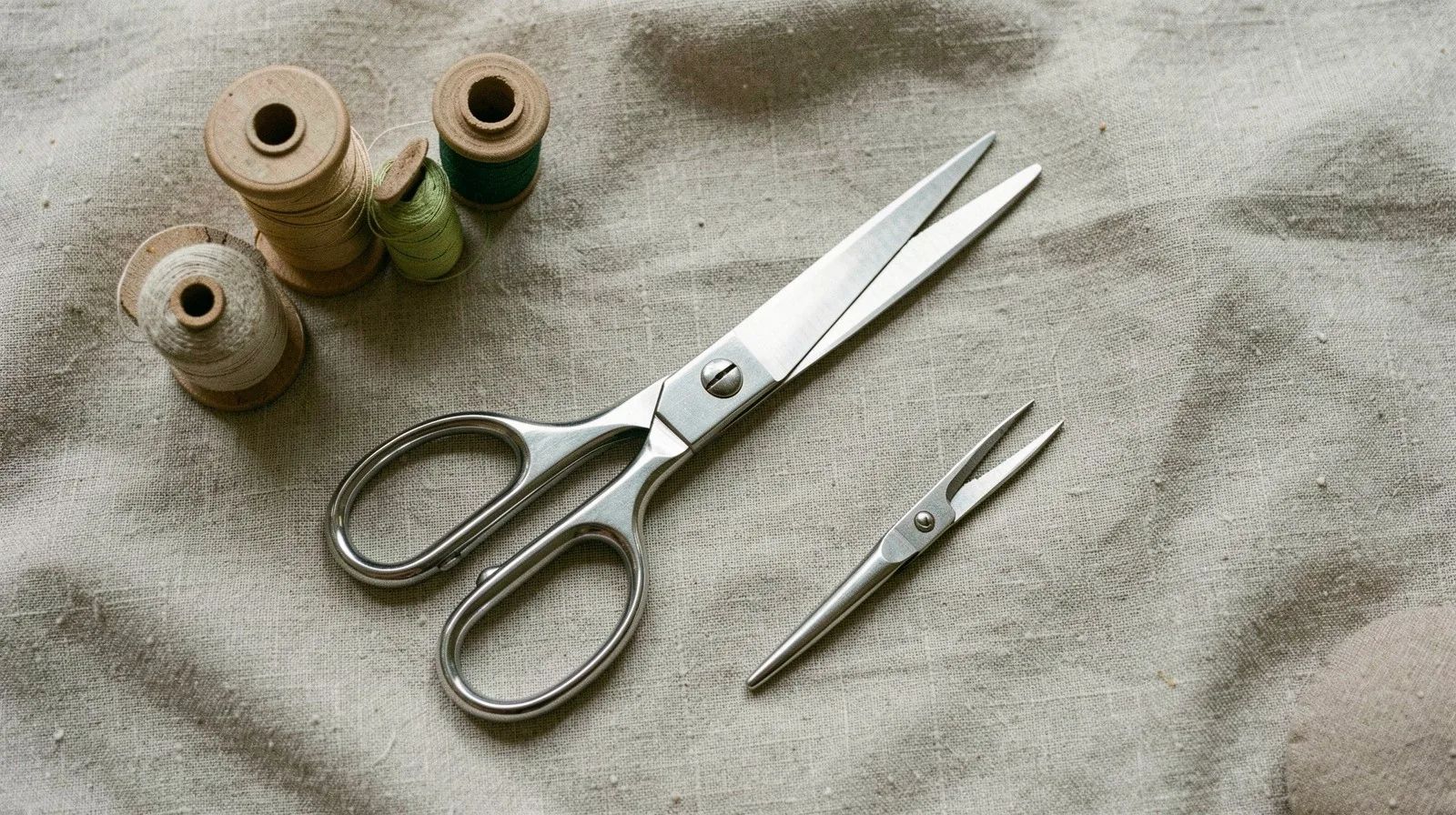
Belongs to the guide: Fabric Scissors: How to Choose Shears for Cloth
Sewing scissors are a small set of tools, each with its own job: long bent-handle shears for cutting cloth, small scissors or snips for thread, pinking shears for seam edges and, as an alternative, a rotary cutter. Start with the main pair in our guide to fabric scissors, then add the rest only as your projects ask for them. This page shows which tool suits which task.
What belongs in a sewing kit?
A practical kit has four to five cutters, and each one earns its place by doing something the others do badly.
- Dressmaker shears. Extension guidance lists sharp shears for cutting fabric and notes that bent-handle shears let the fabric lie flat while you cut.
- Small scissors or thread snips. The same guide suggests keeping small scissors by the sewing machine to clip thread as you sew.
- Pinking shears. (See what the zigzag edge does.) Sewing-industry guidance describes notched or scalloped blades that leave a saw-toothed edge, used to limit raveling in loose weaves, to grade seam allowances and to add decorative edges on fabrics that do not ravel.
- Embroidery scissors. Fine-pointed small scissors for close work; see the guide to fine-pointed snips for close work.
- A rotary cutter and mat (optional). Resembles a pizza cutter, needs a rigid or self-healing mat, and is a different method rather than a different scissor.
Which tool for which task?
| Task | Suited tool | Why |
|---|---|---|
| Cutting out pattern pieces from cloth | Bent-handle shears | Fabric stays flat on the table while you cut |
| Clipping thread at the machine | Small scissors or snips | Quick, light and kept within reach |
| Trimming seam allowances so they do not ravel | Zigzag-edge shears | The zigzag edge limits raveling on loosely woven cloth |
| Notching curves and small details | Shears or small scissors | Short, controlled cuts |
| Close trimming of embroidery or appliqué | Fine-point embroidery scissors | Fine tips reach the stitch without cutting it |
| Long straight cuts through layers | Rotary cutter with mat | Single stroke along a ruler |
| Paper patterns, card, tape | Separate general scissors | Keeps paper off the fabric pair |
The sewing-industry source gives a division of labour worth copying: with shears, keep your free hand on the pattern and cut close to its edge; with a rotary cutter, cut across the top and bottom of each pattern piece first, then the vertical seams, and use shears for the notches.
How to size and weigh your sewing scissors
Size follows task. The sewing-industry source says home sewists generally prefer 10-inch bent-handle shears, and a heavier 12-inch pair is popular with professional dressmakers and tailors. Small scissors for thread are shorter; extension guidance lists them for clipping thread.
The sewing-industry source says to test a pair to decide on the proper weight, size and model for you.
Handle design matters if your hands tire easily. Spring-action shears with padded handles are described as suiting both right- and left-handed users and people with arthritis or other hand concerns. Most scissors are made for right-handed use, but left-handed and ambidextrous models are available.
Shears or rotary cutter?
Both are legitimate. The sewing-industry source describes rotary cutters as having several handle styles and blade sizes, with decorative blades that can be swapped in, and says a rigid or self-healing mat is required. The sewing-industry source says less pressure is needed on a rigid mat because it is less porous than a self-healing one. Extension guidance adds a mat-care point: cut with the blade straight, because cutting at an angle will permanently damage the mat.
Practical ways to decide:
- Long straight edges and stacked layers favour the rotary cutter and a metal or heavy plastic ruler, as the sewing-industry source suggests.
- Curves, notches and small pieces favour shears.
- A rotary cutter needs a rigid or self-healing mat, so allow room for one.
Most sewers end up with both, which is the reason the kit is a set.
Care and storage for the whole set
The same few habits protect every cutter in the kit.
- Give each tool one job and mark the fabric pair so nobody borrows it for paper or tape.
- Wipe lint from blades and pivots after a session.
- Keep pinking shears in a case or fabric pocket, as the sewing guild advises, and store the others closed and protected too.
- Retract or cover a rotary blade when it is not in use; the sewing-industry source says to engage the cover.
- When a pair stops cutting cleanly, have it checked. The sewing-industry source recommends a reputable professional to keep scissors and shears in excellent condition, and our page on how to sharpen fabric scissors explains what is involved.
Sharp-tool safety note
This is general information; follow the maker’s instructions. Keep blades closed when not cutting, never cut toward your hand and take extra care with a rotary blade. Extension guidance notes rotary blades are extremely sharp and says a protective glove can be worn on the hand holding the ruler. OSHA’s hand-tool guidance says knives and scissors must be sharp because dull tools cause more hazards than sharp ones.
Common mix-ups
- Using small thread scissors to cut cloth. Extension guidance lists them for clipping thread and lists separate sharp shears for cutting fabric.
- Cutting out with pinking shears. The American Sewing Guild advises against using them to cut out projects: cut with regular shears, then pink the edges.
- Using one pair for everything. A premium-scissor maker says cutting inappropriate materials can dull the blades and damage the edges.
For a view across kitchen, garden, craft and hair scissors too, read the overview of scissor kinds or try the free tools.
Reviewed by the editorial desk against the cited sources. General information; it does not replace the maker’s instructions.
FAQ
Do I need more than one pair of sewing scissors?
Yes, in practice. One pair of long shears cuts the cloth, but small scissors or snips are easier for clipping threads at the machine, and a separate pair of general scissors takes the paper and pattern-tracing jobs. Extension guidance lists shears for fabric and small scissors for thread as separate basics, which keeps the main pair from being used for everything.
What is the difference between sewing scissors and shears?
The sewing-industry glossary uses length: scissors are under 10 inches with two identical handles, while shears are 10 inches or longer with a rounded thumb bow and a longer bow for the fingers. In shops the words are used loosely, so check the actual length and handle shape rather than the label.
Can I use sewing scissors to cut paper patterns?
It is better not to. A premium-scissor maker says cutting inappropriate materials, even a quick piece of paper, can dull the blades and damage the edges. Cut paper patterns with a separate pair, or trace the pattern first. Extension guidance lists sharp shears for cutting fabric and small scissors for clipping thread, so a general pair for paper is a third, separate tool.
Is a rotary cutter better than scissors?
It depends on the cut. A rotary cutter resembles a pizza cutter and works with a rigid or self-healing mat, which suits long straight lines and stacked layers. Shears are quicker to pick up for curves, notches and small jobs. The sewing-industry source suggests cutting straight lines with the rotary tool and using shears for notches.
Where should sewing scissors be stored?
Store them closed, in a case, sheath or fabric pocket, away from other loose metal tools, and avoid dropping them. Pinking-shear guidance from a sewing guild recommends a case or fabric pocket, and the same advice suits every pair in the kit. Keeping them in one labelled spot also stops other household members borrowing them.
Sources
- Utah State University Extension: Basic Sewing Supplies (extension.usu.edu)
- Sewing.org: Scissor Sense (sewing.org)
- American Sewing Guild: Pinking Shears, A Cut Above (asg.org)
- Whiteley: How to Take Care of Premium Quality Scissors & Shears (whiteley.co.uk)
- OSHA 3080: Hand and Power Tools (osha.gov)
Keep reading
- Fabric Scissors: How to Choose Shears for Cloth
How to choose fabric scissors: bent-handle shears, blade length, edge types, hand fit and left-handed options, plus care so cloth cuts stay clean.
- Pinking Shears: What They Are and What They Are For
Pinking shears cut a zigzag edge that limits fraying on woven fabric. See what they do, where they help, where they do not, and how to look after them.
- Embroidery Scissors: Small Snips for Fine Work
Embroidery scissors are small, fine-pointed scissors for thread and close trimming. What extension and maker sources say about use, storage and sharpening.