Barber Scissors and Shears: Types, Sizes and Care Explained
- First published
- Filed under
- Hair and barber shears
Barber scissors and shears are the precision cutting tools used for hair. In everyday use the two words overlap; the real differences are blade length, edge type, handle style and which hand they are made for. Length is measured from the tip to the outside of the finger ring, and common lengths run from about 4.5 to 8 inches depending on the work.
Barber scissors and shears are the precision cutting tools used for hair. In everyday speech the two words overlap, so what matters is the detail: blade length, edge type, handle style and the hand they are made for. This guide explains those terms, how length is measured and chosen, and basic care. It is explanation only: it does not teach haircuts or offer any salon service.
Scissors versus shears: how are the terms used?
For hair, scissors and shears usually mean the same tool. The sewing-industry glossary draws a formal line by length (scissors under 10 inches, shears 10 inches or longer), but hair-cutting tools are sold in a 4.5 to 8 inch range and are called shears or scissors interchangeably. Do not read much into the word; read the listed length, handle style and edge.
You will also see the phrases barber scissors, hairdressing scissors and hair-cutting shears. They describe the same family. The names tell you the intended use, not a technical difference. The related page on types of hair-cutting scissors covers the object types (straight, thinning, texturizing, curved) in more detail.
What are the parts of a shear?
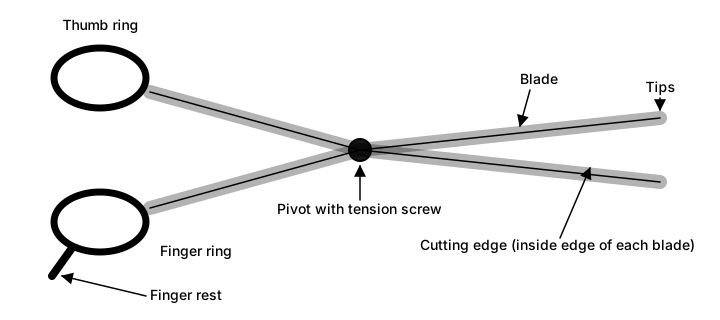
A hair shear is two blades on a pivot, with handles ending in rings or grips. Knowing the parts helps you read a description.
- Blades. The cutting edges, one per side. One blade is fixed on the finger side and one moves with the thumb.
- Pivot and tension screw. The point where the blades meet. The screw sets how firmly they press together.
- Finger ring and thumb ring. Where the hand holds the tool. A removable finger rest (tang) is common.
- Tang or finger rest. A small projection that gives the little finger a place to rest.
- Tips. The points used for fine and detail work.
What blade and edge types exist?
A maker guide describes three edge types:
- Convex. A curved outer edge with an ultra-sharp cutting edge.
- Semi-convex. A slightly curved blade with a narrow beveled edge.
- Beveled. A thick, squared-off edge that needs more force and must be sharpened often.
These are descriptions of the edge geometry, not a ladder of quality. Which edge is right depends on the work and on how often the tool is sharpened.
Handle styles
The same maker guide describes handle (thumb grip) styles:
- Opposing. Finger and thumb holes sit directly across from each other, which forces the thumb back.
- Offset. A slightly shorter thumb blade removes the need to pull the thumb back.
- Crane. An extreme offset thumb that lets you keep the wrist straight and the elbow lowered.
- Further thumb-grip variations include forward set and swivel.
Left-handed users should look for a true left-handed shear. The maker’s test is to hold the shear in the left hand: if the top cutting blade is frontmost, it is a true left-handed shear, and if it sits behind the bottom blade, it is a flipped right-handed shear.
How is length stated and how do you choose it?
Length is the overall length measured from the blade tip to the outside of the finger ring, not including the removable finger rest, according to a maker guide. A second maker explains that blade length is a different measurement, taken from the pivot screw to the tip, so two shears with the same listed size can have different usable blade lengths.
| Length | Typical description | Source note |
|---|---|---|
| 4.5 to 5.5 inches | Detail work and precision cutting | Maker guide: shorter shears |
| 5.5 inches | Versatile everyday size | Second maker guide |
| 5.75 to 6.25 inches | Versatile midsize | Maker guide: midsize shears |
| 6.5 inches and longer | Deep point cutting, slide cutting, shear-over-comb | Maker guide: longer shears |
| 7.5 to 8.5 inches | Specialist lengths for broad cutting; control and technique matter more | Second maker guide |
The second maker offers a hand-fit starting point: close the shear and lay the blade along the open palm and middle finger. The tip should reach the upper section of the middle finger without extending far beyond it. The maker adds that hand size narrows the options but technique makes the final decision. Our hair shear size guide by hand measurement turns this into a simple calculator.
What about steel and finishes?
Most professional shears are stainless steel, according to a maker guide, which also lists many steel names and grades. Those grades vary by maker, and a grade name on its own says little about how a pair will feel or hold an edge, so look for the maker’s own description and care instructions rather than relying on a label. This page does not rank steels.
How do you care for hair shears?
Care for a hair shear comes down to cleaning, oiling the pivot and checking tension. The maker’s routine is a good model, though you should follow your own maker’s instructions.
- Clean. A maker’s guide describes using rubbing alcohol and a cotton ball to remove styling residue, taking care around the blade edges. Residue left on blades can lead to corrosion, which that guide links to hair, styling residue, moisture and chemicals.
- Oil the pivot. The same guide holds the shears tips-down with the blades open at about 45 degrees, adds a couple of drops of shear oil at the pivot, opens and closes, and lets them sit overnight; the oil flushes out hair built up in the pivot. Wipe clean afterward. Always check whether your pair has a dry or sealed pivot first, as the maker’s instructions will say.
- Check tension. Shears loosen over time. A maker guide says too little tension makes them fold and push hair instead of cutting, and too much wears the edges and strains the hand. Its method is to loosen the blades 1 to 2 clicks, lift the finger blade to about 45 degrees and release; if the blades close on their own, increase tension by one click or one turn of the screw, and repeat until the finger blade stays still.
- Store closed and dry. A case or sleeve keeps tips protected.
- Sharpen through a competent service. See the page on sharpening hair shears for the options explained.
Disinfection wording
Where tools are used on other people, state barber and cosmetology boards set the rules, and they differ by state. As one example, the California Board of Barbering and Cosmetology’s consumer factsheet describes washing a tool with soap and water, then immersing it in an EPA-registered disinfectant for the manufacturer’s recommended time, and storing it in a clean, closed container. Professionals must follow their own state’s current rules; this page is not a substitute.
Sharp-tool safety note
This is general information; follow the maker’s instructions. Fine tips can injure. Keep the blades closed when not cutting, keep the pair away from children and never test sharpness on skin. OSHA’s hand-tool guidance says knives and scissors must be sharp because dull tools can cause more hazards than sharp ones.
Related guides
- What thinning shears are and how they are handled.
- Straight, texturizing and curved hair scissors for the object types.
- Types of scissors for the wider family.
- Free tools for the size guide and type picker.
Reviewed by the editorial desk against the cited sources. General information about tools; it is not a haircutting guide, a salon service or professional advice.
All Hair And Barber Shears guides
- Hair Scissors: Straight, Texturizing and Left-Handed
Hair scissors explained: how they differ from household scissors, the main types, handle styles, left-handed designs, edge grades and basic care.
- How Thinning Shears Are Used: Handling Explained
How thinning shears are held and handled, how makers describe their use, common mistakes with the tool, and how to clean and store them safely.
- Thinning Shears: What They Are and How They Work
Thinning shears have one straight blade and one toothed blade. Learn how the teeth work, how thinning, texturizing and blending shears differ, and care.
FAQ
What is the difference between scissors and shears?
The terms overlap in everyday use. In the sewing-industry glossary, scissors are under 10 inches with two identical handles and shears are 10 inches or longer, but hair tools do not follow that rule: hair shears are normally 4.5 to 8 inches. For hair, the words scissors and shears usually mean the same kind of tool.
What size is common?
A maker guide describes a standard cutting shear as 5.5 to 6.25 inches, with shorter shears of 4.5 to 5.5 inches for detail work and 6.5 inches and longer for shear-over-comb and deep point cutting. Another maker describes 5.5 inches as a versatile everyday size. Size is a starting point; technique makes the final decision.
How is the size of a hair shear measured?
Listed size is the overall length measured from the blade tip to the end of the longest finger ring, usually excluding the removable finger rest. Blade length is a different measurement, taken from the pivot screw to the tip, so two shears with the same listed size can have different usable blade lengths. Check which one a listing means.
What does a convex edge mean?
A convex edge has a curved outer profile that comes to a very fine cutting edge, A maker guide describes it as an ultra-sharp cutting edge. A semi-convex edge is slightly curved with a narrow bevel, and a beveled edge is thick and squared off, needing more force and frequent sharpening. This explains the edge, not a ranking.
Can I use barber scissors on anything other than hair?
Keep hair shears for hair. A premium-scissor maker says cutting inappropriate materials, even a quick cut of paper, can dull the blades and damage the edges, and a hair-shear maker says to send a shear in for service after cutting through foil. Keep a separate pair of general scissors for other work and store the shears closed in a case. See the care section for cleaning and oiling.
Do hair shears need disinfecting?
Where hair tools are used on other people, state barber and cosmetology boards set the rules. As an example, one state board lists washing with soap and water, then immersing in an EPA-registered disinfectant for the manufacturer's recommended time. Licensed professionals follow their own state's rules; this page explains tools, not salon practice.
Sources
- Sam Villa: The Ultimate Professional Hair Cutting Shear Guide (samvilla.com)
- Hanzo: How to Find the Right Shear Size for Your Hand (hanzo.com)
- Sam Villa: Shear Maintenance, How to Oil and Care for Your Shears (samvilla.com)
- California Board of Barbering and Cosmetology: Infection Control in the Salon (factsheet) (barbercosmo.ca.gov)
- Whiteley: How to Take Care of Premium Quality Scissors & Shears (whiteley.co.uk)
- Hanzo: How to Clean, Oil and Sterilize Scissors (hanzo.com)
- Sewing.org: Scissor Sense (scissors versus shears terminology) (sewing.org)
- OSHA 3080: Hand and Power Tools (osha.gov)
Keep reading
- Thinning Shears: What They Are and How They Work
Thinning shears have one straight blade and one toothed blade. Learn how the teeth work, how thinning, texturizing and blending shears differ, and care.
- Hair Scissors: Straight, Texturizing and Left-Handed
Hair scissors explained: how they differ from household scissors, the main types, handle styles, left-handed designs, edge grades and basic care.
- How Thinning Shears Are Used: Handling Explained
How thinning shears are held and handled, how makers describe their use, common mistakes with the tool, and how to clean and store them safely.