Fabric Scissors: How to Choose Shears for Cloth
- First published
- Filed under
- Sewing and fabric
Fabric scissors, usually called dressmaker's shears, are long-bladed cutters with a bent handle that lets cloth lie flat on the table while you cut. Choose by blade length, edge type, handle fit and the hand you cut with, then keep them for fabric only. This guide explains each choice and how to look after the pair.
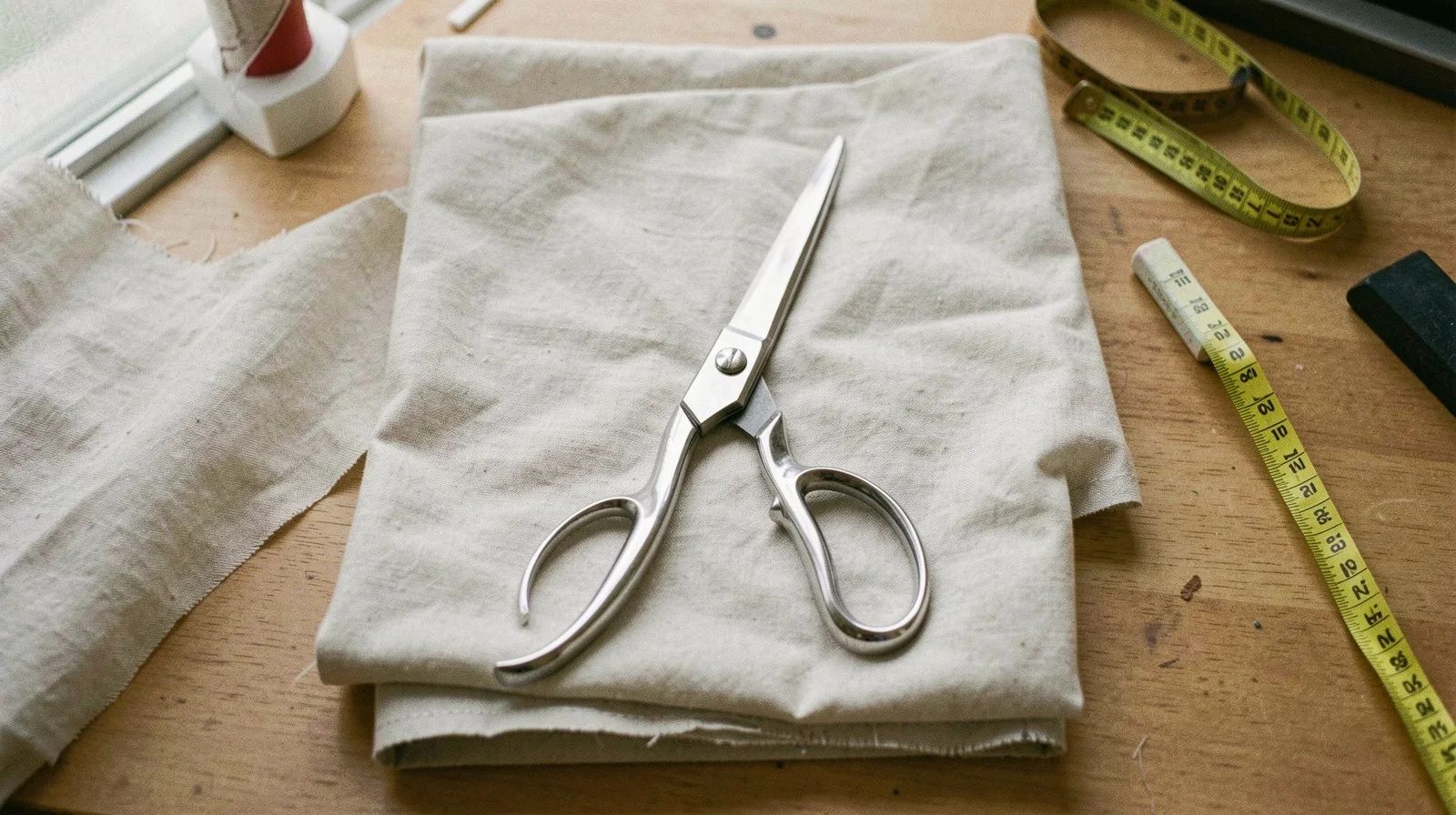
Fabric scissors, most often sold as dressmaker’s shears, are long-bladed cutters with a bent handle that lets cloth lie flat on the table while you cut. Picking a pair comes down to a handful of choices: blade length, edge type, handle fit and which hand you cut with. Once you own a pair, the biggest factor in how long it cuts well is simple: use it for fabric only. If you are comparing the whole sewing kit, start with our guide to the rest of the sewing kit.
What makes fabric shears different?
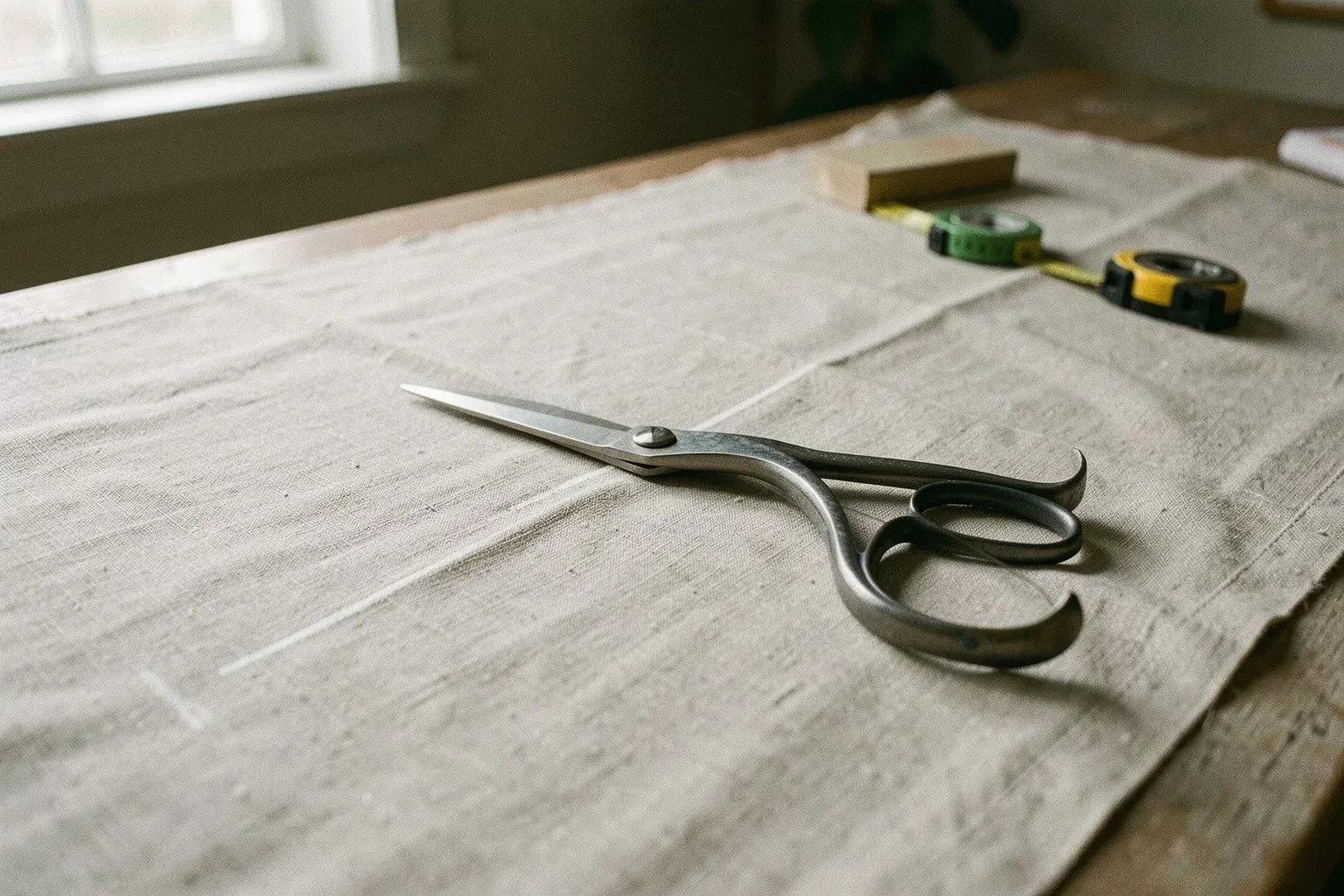
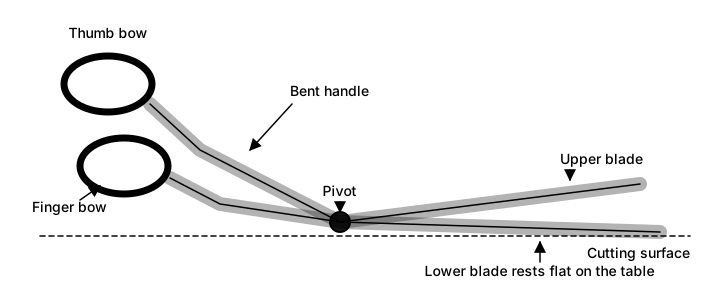
Fabric shears differ from household scissors in three ways: a bent handle, longer blades and an edge kept sharp for textiles rather than for paper or packaging. A state university extension sewing guide advises choosing sharp shears for the best cutting results and notes that bent-handle shears let the fabric lie flat while you cut.
That bend is the point of the design: the extension guide says it lets the fabric lie flat while you cut.
The sewing-industry glossary draws a line between the two words people use for these tools: scissors are under 10 inches long with two identical handles, while shears are 10 inches or longer with a rounded thumb bow and a longer, elliptical bow for two or more fingers. In everyday speech the terms overlap, and shops use them loosely, so read the listed length rather than the word on the label.
How long should fabric shears be, and who do they suit?
Choose a length you can control through a full cutting stroke. The sewing-industry source says home sewists generally prefer 10-inch bent-handle shears, while a heavier 12-inch pair is popular with professional dressmakers and tailors. That is a description of common preference, not a rule.
Use these practical checks when you try a pair:
- Open and close the blades fully. One maker advises checking that the blades move smoothly along their full length.
- Check the weight. Weight is a matter of feel; the sewing-industry source suggests trying a pair before you buy.
- Look at the handles. Your thumb and fingers should fit the bows without being squeezed, and the bows should not press on a knuckle.
- Cut a scrap of the fabric you use most. The sewing-industry source suggests testing several pairs to find the right weight, size and model.
Hand size and arthritis
Spring-action shears with padded handles are described by the sewing-industry source as suitable for right- and left-handed users and for people with arthritis or other hand concerns.
Left-handed cutters
Most shears are made for right-handed use, but left-handed and ambidextrous models are available, and extension guidance confirms left-hand shears exist. If you cut with your left hand, a true left-handed pair will keep the cutting line visible instead of hiding it behind the upper blade. Our guide to left-handed scissors explains how to tell a true left-handed pair from a flipped right-handed one.
Which blade type: straight, serrated, micro-serrated or pinking?
Straight-edge shears are the general choice for cloth. Other blade types solve specific problems.
| Blade type | What it does | Where it helps | Limit |
|---|---|---|---|
| Plain straight edge | Clean, smooth cut | Most woven fabrics | Can slip on very slippery cloth |
| Micro-serrated | Fine teeth grip the cloth | Thin, sheer or slippery fabrics (per the sewing-industry source) | Needs specialist sharpening |
| Pinking | Zigzag or sawtooth edge | Seam allowances, hems, decorative edges on non-fraying cloth | Not for cutting out pattern pieces |
| Rotary cutter (alternative) | Round blade rolled over a mat | Long straight cuts, many layers | Needs a mat and careful handling |
Pinking shears are a finishing tool rather than a first pair. American Sewing Guild guidance describes using them to trim seam allowances, hems and facings and to create decorative edges on fabrics that do not fray, such as fleece, felt and vinyl. Our guide to the zigzag-edge finishing tool covers what they do and do not do.
The sewing-industry source describes micro-serrated blades as suited to thin, sheer or slippery fabrics. If you find that a plain edge keeps slipping on a slippery cloth, that is the feature to look for.
What about materials and handle comfort?
Shears are described as two sharpened steel or aluminum blades that pivot against each other, according to the sewing-industry source, and some carry a coating that resists corrosive materials and sticky adhesives. Beyond that, the detail that matters most is how the pivot feels. A good pair closes smoothly along the whole length of the blade with no gap that lets cloth fold between the edges.
The sewing-industry source describes shears with a rounded thumb bow and a longer elliptical bow for two or more fingers, and spring-action shears with soft, padded handles. Check that the handles fit your hand.
The sewing-industry source describes rotary cutters as needing a rigid or self-healing mat, and says to keep the blade sharp and the cover engaged when not in use.
How do I care for fabric scissors?
Keep fabric shears for fabric, wipe them clean, and store them so the blades cannot knock against other tools. These habits matter more than any single product.
- Fabric only. A premium-scissor maker says cutting inappropriate materials, even a quick piece of paper, can dull the blades and damage the edges. Put a label on the handle so family members do not borrow them.
- Clean the blades. The sewing guild’s pinking-shear guidance says to keep the blades free of lint for the sharpest cut.
- Oil lightly if the maker says to. A drop of scissor oil on the pivot is the maker advice we opened; keep oil off the fabric and check your own maker’s instruction.
- Store in a case or sheath. A premium-scissor maker advises a protective case and says not to toss scissors loose into a drawer where they can nick or misalign the blades.
- Sharpen when needed, using the right method. The sewing-industry source recommends a reputable professional to keep scissors and shears in excellent condition. See the guide to sharpening fabric scissors before you try it yourself.
For general cleaning, oiling and storage routines across all kinds of scissors, read scissor safety and care.
Sharp-tool safety note
This is general information. Follow the maker’s instructions for your pair. Cut away from your hand and body, close the blades when you put them down, and pass them handle first. OSHA’s hand-tool guidance says knives and scissors must be sharp because dull tools can cause more hazards than sharp ones, and it advises examining each tool for damage before use and not using damaged tools.
How do fabric shears fit with the rest of the sewing kit?
Fabric shears do the main cutting. Smaller tools handle everything else: thread snips for trimming ends, small snips for fine work (fine-point embroidery tools), pinking shears for seam finishing. The sewing kit guide matches each of these to the task in a table. If you are also working out how scissors differ across kitchen, craft and garden tasks, see the scissors family overview, and the free tools include a scissor type picker that narrows the choice by material and task.
A short checklist before you choose
Work through these in order and the shortlist usually makes itself:
- Which hand? Decide right, left or either first. It removes more options than any other feature.
- Which fabrics? Mostly cotton and linen suggests a plain edge. Mostly thin or slippery cloth suggests looking at micro-serrated edges.
- How much cutting? Occasional hemming and repairs do not need a heavy pair. Long sessions reward comfortable, padded handles or spring action.
- How big are the pieces? The extension guide notes that shears come in a variety of blade lengths; choose a length you can control through a full stroke.
- Who will service it? If the pair can be sharpened by a reputable professional, it can serve for years. Ask the maker how, before you buy rather than after the edge goes dull.
- Does it feel right closed? Close the blades slowly. They should meet along their full length with no gritty spots.
Common mistakes
- Buying by length alone without checking the handle fit.
- Lifting the fabric off the table to cut it with a straight-handle pair.
- Letting the pair become the household scissors for paper, tape and packaging.
- Pushing a dull pair harder instead of having it sharpened.
- Storing the blades open or loose where the points can be damaged.
This page was reviewed by the editorial desk against the cited sources. It is general information for choosing and caring for tools; it does not replace the maker’s instructions.
All Sewing And Fabric guides
- Embroidery Scissors: Small Snips for Fine Work
Embroidery scissors are small, fine-pointed scissors for thread and close trimming. What extension and maker sources say about use, storage and sharpening.
- Pinking Shears: What They Are and What They Are For
Pinking shears cut a zigzag edge that limits fraying on woven fabric. See what they do, where they help, where they do not, and how to look after them.
- Sewing Scissors: Which Pair for Which Task
A sewing kit usually needs more than one cutter. See which scissors, shears, snips and rotary tools suit each task, and how to store and care for them.
FAQ
Why not use fabric scissors on paper?
A premium-scissor maker says most premium scissors have a designated purpose, and that cutting inappropriate materials, even a quick piece of paper, can dull the blades and damage the edges. Keep a separate pair of general scissors for paper, card and tape, and label the fabric pair.
How long should the blades be?
There is no single correct length. The sewing-industry source notes that home sewists generally prefer 10-inch bent-handle shears, and a heavier 12-inch pair is popular with professional dressmakers and tailors. Longer blades make long, even strokes through big pieces of cloth; shorter ones are easier to control on small pieces. Pick the length your hand and table can manage comfortably.
Are bent-handle shears better than straight-handle scissors?
For cutting cloth on a table, bent handles help because they let the fabric lie flat while you cut, as a state university extension sewing guide notes. Extension guidance also lists small scissors for clipping thread. Match the pair to the task.
Do left-handed people need left-handed fabric shears?
Most shears are made for right-handed use, but left-handed and ambidextrous models are available. Spring-action shears with soft, padded handles are described by the sewing-industry source as suiting both right- and left-handed use, so they are another option to try if a true left-handed pair is hard to find locally.
Can I sharpen fabric scissors myself?
It is possible, but the sewing-industry source recommends using a reputable professional to keep scissors and shears in excellent condition, and the blade angle matters. If you do sharpen at home, follow the maker's instructions first and read our guide on how to sharpen fabric scissors without ruining them before touching the edge.
How do I know my fabric scissors have gone dull?
A scissor maker lists material folding or snagging, uneven or inconsistent cuts, increased resistance while cutting and slipping on smooth surfaces. The same maker says dirt build-up or incorrect adjustment can mimic a dull edge, so clean the blades and check the screw, then test on a scrap of the fabric you actually use before deciding it needs sharpening or service.
Sources
- Utah State University Extension: Basic Sewing Supplies (extension.usu.edu)
- Sewing.org: Scissor Sense (scissors, shears, pinking shears, micro-serrated blades) (sewing.org)
- American Sewing Guild: Pinking Shears, A Cut Above (asg.org)
- Whiteley: How to Take Care of Premium Quality Scissors & Shears (whiteley.co.uk)
- Victorinox: How to Sharpen Scissors (victorinox.com)
- OSHA 3080: Hand and Power Tools (osha.gov)
Keep reading
- Pinking Shears: What They Are and What They Are For
Pinking shears cut a zigzag edge that limits fraying on woven fabric. See what they do, where they help, where they do not, and how to look after them.
- Embroidery Scissors: Small Snips for Fine Work
Embroidery scissors are small, fine-pointed scissors for thread and close trimming. What extension and maker sources say about use, storage and sharpening.
- Sewing Scissors: Which Pair for Which Task
A sewing kit usually needs more than one cutter. See which scissors, shears, snips and rotary tools suit each task, and how to store and care for them.