Electric Scissors: Types, Uses and Safety
- Review by
- Edge & Pivot Editorial Team
- Last checked
- First published
- Filed under
- Kinds of scissors
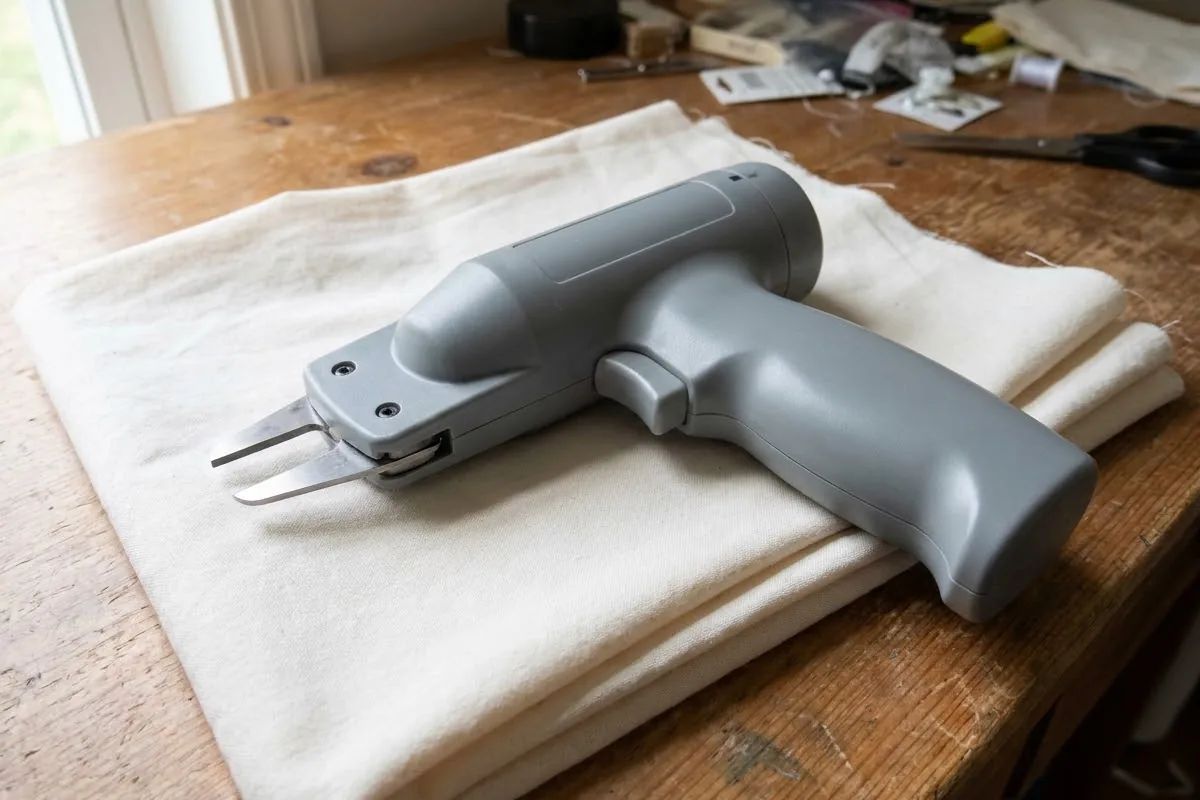
Electric scissors are powered cutters with a moving blade, usually cordless and rechargeable, for soft, flexible materials such as fabric, cardboard and leather. Always follow the maker's instruction sheet: it sets the material limit, the charging rules and how to change blades safely. Keep fingers clear of the blade, switch off before service and never open or crush the battery.
Belongs to the guide: Types of Scissors: A Guide to Every Kind
General information, not professional advice. Electric scissors have a moving blade and a battery. Follow the maker’s instruction sheet for your model; this page does not replace it.
Electric scissors are powered cutters, usually cordless and rechargeable, for cutting soft, flexible materials. They are one of the kinds covered in our overview of every scissor kind. This page explains the types, what they suit, the safety rules from a maker’s instruction sheet and how to care for them. We do not review or recommend products.
What electric scissors are
An electric scissor uses a motor to move a blade against a guard, so you guide the tool rather than squeeze handles. The a maker instruction sheet describes cutting flexible, soft materials, such as carpet, PVC, cardboard, leather and fabrics, up to 6 mm thick. Other makers set their own limits, which is why you should read the sheet for the exact model.
Corded and cordless types
Cordless pairs run on a rechargeable battery and charge through a cable. Corded types draw mains power. Cordless is easier to move around a table; corded avoids battery limits but ties you to an outlet. Whichever you use, the maker’s sheet governs charging, storage and replacement parts. The sheet we read says to use only identical replacement parts when servicing.
Safe use
- Keep hands clear. The sheet warns not to touch the blade or bring the tool near hands or face when operating, and never to put a hand in front of the blade.
- Hold fabric under tension. Thin materials can be pulled into the tool and wedge, so do not press hard; cut slowly.
- Use the trigger lock. The sheet describes a trigger-lock button that must be pressed before the trigger will start the tool; check whether yours has one.
- Eye protection. The sheet says to always wear eye protection.
- Keep children away. Keep children and bystanders away while operating.
- Dress properly. Keep hair, clothing and gloves away from moving parts.
OSHA adds that power tools should be disconnected before servicing, cleaning and when changing accessories such as blades, and that cords should be kept away from heat, oil and sharp edges.
Battery safety
Treat the battery with respect. The a maker sheet says not to dismantle, open or shred the battery, not to expose the tool to heat or fire, to avoid storage in direct sunlight and not to store it where the charging terminal could touch metal such as paper clips, coins, keys, nails or screws, since shorting can cause burns or fire. It also says to let a hot tool cool before recharging. Follow the charging instructions in your sheet.
Care and blade replacement
Disconnect the tool before cleaning. The sheet recommends dry compressed air with safety goggles, regular cleaning under the upper guard with the blade removed, and avoiding solvents or ammonia cleaners that can damage plastic. To change a blade, the sheet describes removing the blade screw with a small slotted screwdriver, sliding the old blade out from under the guard and fitting the new blade with beveled edges facing out. Follow the steps for your own model.
Manual versus electric
| Electric | Manual | |
|---|---|---|
| Effort | Motor cuts, you guide | Hand squeeze |
| Material range | Maker’s soft-material limit | Wide, by pair |
| Risks | Battery and moving blade (see the maker’s sheet) | Sharp edge |
| Upkeep | Blade swaps, cleaning, charging | Oil, sharpen |
Manual pairs are covered in the kitchen scissors guide and fabric scissors; the care routine is in scissor safety and care. For the naming question, read whether shears and scissors differ in the kitchen.
FAQ
Do electric scissors cut thick fabric?
Only within the maker's stated limit. One maker's cordless pair is intended for flexible, soft materials up to 6 mm thick, including carpet, PVC, cardboard, leather and fabrics. Its sheet also warns that thin fabrics can be pulled into the tool and wedge, so hold the fabric under tension and cut slowly. For thicker or tougher material, use a tool the maker rates for it.
How should I charge electric scissors safely?
Follow the maker's charging instructions exactly. One sheet says to refer to the manufacturer's instructions for charging, not to expose the tool to heat or fire, not to open the battery and to let a hot tool cool before recharging.
Are electric scissors safe for children?
They are not toys. One maker's sheet says to keep children and bystanders away while operating a power tool because distractions can cause loss of control. The CPSC Art and Craft Safety Guide says there is no substitute for direct supervision with children. Store the tool and charger out of reach and keep the trigger lock engaged.
How do I change the blade on electric scissors?
Follow the maker's steps for your model. One sheet describes loosening the blade screw, sliding the blade away from the guard, fitting a new blade with the beveled edges facing out and retightening. OSHA's general advice is to disconnect power tools before changing accessories such as blades. Wear eye protection and never touch the blade while the trigger could be pressed.
Should I choose manual or electric scissors?
Choose by job. Electric scissors are intended for cutting soft, flexible materials within a maker's thickness limit, while manual scissors need no charging and have no battery. Check the maker's sheet for what a given electric model is intended to cut. Our types of scissors guide helps you match a pair to a task.
How do I clean electric scissors?
Disconnect the tool and charger first. One maker's sheet says dry compressed air cleans the tool best, with safety goggles worn, and that residue builds up under the upper guard, so remove the blade and clean the guard with a brush or damp cloth. It warns that certain solvents and ammonia cleaners damage the plastic.
Sources
- Powertec: 3.6V Cordless Scissors instruction sheet (ESS3600) (powertecproducts.com)
- OSHA: Hand and Power Tools (publication 3080) (osha.gov)
- CPSC: Art and Craft Safety Guide (Pub. 5015) (cpsc.gov)
Keep reading
- Kitchen Scissors: What They Do and How to Care for Them
What kitchen scissors are used for, features such as take-apart blades, dishwasher questions and food-safety cleaning after raw meat or poultry.
- Left-Handed Scissors: How They Work and How to Choose
How left-handed scissors differ from right-handed pairs, true left-handed versus symmetrical handles, and how to choose for adults, fabric and garden.
- Types of Scissors: A Guide to Every Kind
A guide to the main types of scissors and shears, grouped by task, material and handedness, with how scissors differ from shears and snips.
- Kitchen Shears vs Kitchen Scissors: Is There a Difference?
Kitchen shears and kitchen scissors overlap in meaning. Learn how the words are used, what features to look for and which term to search or use.
- Scissor Safety and Care: Cleaning, Oiling and Storing
Safe handling, cleaning by material, oiling the pivot, adjusting tension, storing and teaching children to use scissors, with maker and CPSC sources.